Bespoke at Objectspace
Written by
Bespoke: the pervasiveness of the handmade curated by Anna Miles
Objectspace - 19 May - 10 June
Bespoke looks at the origin of the commissioned object. Objectspace director Philip Clarke writes, "While the word 'bespoke' has an old fashioned ring it's associations of patience, time and skill on the part of makers and of discernment, appreciation and celebration on the part of customers - which are conjoined by processes of discussion and negotiation - highlight that the 'bespoke' embodies qualities that are of enduring human relevance."
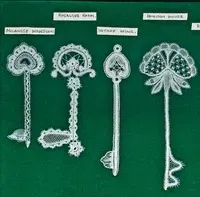
Image: Alwynne Crowsen, Key Sampler c1990 - keys to the lace castle.
Read on for Preservation of Traditional Knowledge - by Finn Ferrier the first of three essays from the Bespoke catalogue to be published on www.thebigidea.co.nzBespoke: the pervasiveness of the handmade curated by Anna Miles
Objectspace - 19 May - 10 June
Bespoke looks at the origin of the commissioned object. Objectspace director Philip Clarke writes, "While the word 'bespoke' has an old fashioned ring it's associations of patience, time and skill on the part of makers and of discernment, appreciation and celebration on the part of customers - which are conjoined by processes of discussion and negotiation - highlight that the 'bespoke' embodies qualities that are of enduring human relevance."
Image: Alwynne Crowsen, Key Sampler c1990 - keys to the lace castle.
Read on for Preservation of Traditional Knowledge - by Finn Ferrier the first of three essays from the Bespoke catalogue to be published on www.thebigidea.co.nzBespoke the exhibition looks at the pervasiveness of the handmade object, outside of Objectspace's usual field of art/craft and presents an eclectic sampler of handmade objects made within the context of business, or with such expertise that they cannot be regarded as amateur. Bespoke is a term for that which is 'ordered' rather than ready-made and the exhibition looks at bespoke items made for reasons of; Idiosyncrasy of the body (artificial teeth), Ritual, sentiment and occasion (ecclesiastical embroidery) , Quality and high performance (Mark Inglis's Paralympic Replacements), Replication and restoration (carved gilded mirrors), Prototyping for production (architectural models), Preservation of traditional knowledge (lace fan).
11am June 10 Curator Anna Miles will talk with and about some of the makers featured in Bespoke.
***************************************************
Preservation of Traditional Knowledge - by Finn Ferrier
In the school holidays I used to go down to my auntie's farm. One of the many things I remember doing was brushing the angora rabbits, or pulling apart sheep's wool and then help card the wool and prepare the rolags. She would then spin the wool on her wheel, preparing it for weaving on the loom. The loom always had a cushion cover or a rug half made on it.
The finished rugs were lumpy horizontal landscapes made from streaks of browns, yellows and oranges, which darted in and out of the warp threads. These rugs were warm and always had a faint oily smell of lanolin.
The handmade object exists, purely because of the skill and the knowledge of the maker. This keeper of the knowledge knows how to choose materials that are superior, discarding the lesser parts of the material by touch and a keen eye. It is this fact alone that allows hand made items to exist today. The handmade never skimps on materials, and is always made with the best intention. The product is the pride of the maker, whose reputation is often subject to it.
The machine, on the other hand, which was made to free the maker from doing work, does not have a critical eye, nor a creator's touch. It makes only what it has been designed to do. The machine has been calibrated so finely that the materials can be used sparingly. So sparingly that they often just serve their purpose, and no more. So the product is often throwaway and not cherished. The saying "they don't make things like they used to" comes to mind. "They" were not machines, they were people who knew how to make things which would exist for the use, and last for the life, of the maker (and longer).
Handmade items now, whether they be curtains, shoes, a gift from a friend or even baking, are revered by the receiver. They are even sometimes considered a 'luxury'. Making something well, requires time to practice and time to learn from mistakes or just to learn from doing. This is why specialist family businesses are often so excellent. The family trade, what-ever it may be, has tools and knowledge built up over time, and which keep accumulating across generations. The understanding or the feeling of what makes the product good, comes by nature rather than by study.
Historically things were handmade because they had to be. Things were often passed down and kept because they were too expensive to replace, not because of historical value. The post-industrial age made new things affordable, new shapes and products entered everyone's homes and psyche. Things that weren't broken were being thrown out, and things that were perfectly fine were being modernised. The handmade started dreaming of machines. Makers aspired to the new, standardised fashions. Cabinet-makers were chopping off superfluous ornaments or accessories. Potters were throwing clay and turning it on a lathe to make 'perfect' geometric straight edge forms: Hand was replicating machine.
In the 1950's, old values were being replaced with new ones. Society moved away from the community where you knew the maker, where there was value in labour. The machine's labour and product undercut the handmade. The machine removed the regional differences, and enabled the same fashion everywhere. But by the 60's and 70's people began reacting to the machine. They were looking for the old society where objects and labour had real value, not a contrived value put on by advertisers. The handmade object was seen as reflecting something lost, old values of time, and beauty in the detail. Knowing the maker is an attractive attribute, which gives a sense of community and place.
Before long the machine was programmed to make things look handmade. Pottery had irregular edges and seemingly random glazes, veneer was put on furniture to resemble solid wood, plastic was made to look like bone and glass. New forms imitated the old forms that they were destined to overcome.
The role of the maker today is complicated. Traditional trades that were once useful are now specialised and seen as a quaint throwback. These specialised handmade trades are an alternative to the machine-made world we live in. Fashion moves in cycles, so when people get sick of having machine-made, they'll move to the handmade and back again. Therefore the maker's survival is precarious and unpredictable, so they rely on the public sense of 'quality' which usually characterises handmade objects. Because of this association, objects that are made or decorated by hand are usually advertised being so. The maker's name is often the symbol for the quality - they become a brand. The pleasure of the maker comes with the pleasure of selling and making objects with a skill and touch that is their own, and an enjoyment in producing something different to what is otherwise available. Makers are often proud that they are keeping a trade going, that they are connecting with a way of life that once was, or holding up family tradition and keeping a quality alive.
Not everything handmade is quality. Some handmade objects are poorly designed and constructed. The idea of handmade often comes with a snobbery that holds it above machine-made things. The handmade is seen as extraordinary, we treasure it because we could never make it, and nor could a machine. When looking for this handmade quality, it is often only after handling and comparing handmade products that we will be able feel the inherent qualities in the objects.
Finn Ferrier
Finn Ferrier, is a practicing artist who lives and works in Auckland
Alwynne Crowsen established the Embroiders and Lacemakers' Guild in 1970 (five years earlier than the English Lace Guild). As well as her involvement in Guild activities (not for the first time, she is President again) she teaches three classes a week. Often on a Friday she can be found volunteering in the Applied Arts Department of Auckland Museum where she works on the cataloguing of the Museum's lace collection. In her own making, Crowsen likes to sample each country's lacemaking. Here just six of the traditions she is familiar with, have been delightfully assembled as keys to the 'lace castle'.