Bert van Dijk returns from the 2004 Chekov Festival & Workshop
Written by
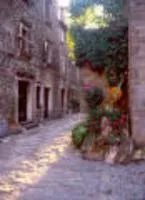
by Bert van Dijk
This winter I took part in the 2004 International Michael Chekhov Workshop & Festival, which was jointly organised by MICHA (Michael Chekhov Association), The Academy of Dramatic Arts (Zagreb) and ETRA (Studio Dramske Umjetnosti) and took place in the Croatian town of Groznjan from July 3 - July 12, 2004.
by Bert van Dijk
This winter I took part in the 2004 International Michael Chekhov Workshop & Festival, which was jointly organised by MICHA (Michael Chekhov Association), The Academy of Dramatic Arts (Zagreb) and ETRA (Studio Dramske Umjetnosti) and took place in the Croatian town of Groznjan from July 3 - July 12, 2004.
The Workshop & Festival offered professional training in the acting method of Michael Chekhov to actors, directors and theatre pedagogues from around the world. It also provided a platform to share and demonstrate film and theatre works created through use of the Michael Chekhov method.
Groznjan is a delightful small medieval town on top of a huge hill overlooking the Adriatic Sea. The town functions as an arts centre, hosting a number of national and international music, visual art and theatre courses and events.
The narrow streets are filled with the sounds of cello, piano and song and everywhere people paint, sculpt, dance or act. Meal times are the highlight of the day with the artists gathering in the square for chat and food.
This year the Workshop & Festival attracted 76 actors and directors from 19 different countries. Mostly from the USA and Croatia but also the Kingdom of Bahrain, Finland, Italy, Spain, Serbia, Bosna, Montenegro, Israel, Denmark, Belgium, the Netherlands, Canada, England, Germany, Slovakia and New Zealand were represented. The Faculty consisted of the 9 expert tutors / directors from USA, UK, Germany and Israel.
Michael Chekhov:
Michael Chekhov (1891 - 1955) was the nephew of the playwright Anton Chekhov and was considered by Stanislavsky to be his most brilliant student. Stanislavsky once said that if anyone wanted to know what he was teaching, they should go and see what Michael Chekhov was doing.
After heading the second Moscow Art Theatre Studio Michael Chekhov travelled and worked extensively in Europe in the 1920's and 1930's and in 1939 he moved to the United States where he taught in both New York and Hollywood.
In 20th century America and Europe most approaches to acting stem from the pioneering work of Constantin Stanislavsky. Although Stanislavsky's research continued throughout his life and evolved far beyond mere "naturalism", his impact in the United States is largely limited to the "Method" School of acting. In reality, Stanislavsky and his disciples moved far beyond the original ideas. They developed a theatre that was bolder and more expressive and imaginative, using psychophysical techniques that liberated and excited actors, but have only recently begun to be appreciated and understood.
The psychophysical approach is most fully exemplified and realised in the work of Michael Chekhov. He developed an approach to acting that affords the actor access to resources within him- or herself (feelings, will impulses, character choices) that are based not merely in personal experience as they are in "Method" training, but on the actor's imagination and physical life.
In 1942 Chekhov was invited to Hollywood and became an acting coach to the stars, acted in many films and published his book "To the Actor". Prominent actors who studied with him were: Gary Cooper, Marilyn Monroe, Gregory Peck, Patricia Neal, Clint Eastwood, Ingrid Bergman, Annthony Quin and Yul Brunner.
But, he died in 1955, before his work became widely known, and by then the "Method" was widely established as the dominant approach to acting and training. It is only in the last 10 years or so that we observe a worldwide revival of interest and appreciation in his concepts and techniques.
Relevance to my work in New Zealand:
My own training and experience is mostly in Modern European theatre with a strong emphasis on choreographic image, the physical foundation of acting and the devising process.
In New Zealand the dominant approach to theatre is still mainly concerned with naturalism and the spoken word. For this reason I have shifted my efforts in the last 5 years towards directing plays. In my search for a method of text analysis, that would still honor the body and the imagination, I stumbled by chance upon a couple of books written by Michael Chekov. His approach to acting instantly excited me and seemed surprisingly in harmony with the theatre principles that I developed myself over the years. It seemed to hold a key for building a bridge between the physical European approach to theatre and the New Zealand text-based approach.
As there are no teachers or directors in NZ who are trained in his methodology, I was forced to work more or less straight from the textbooks, experimenting and following my own intuition. I subsequently used the Chekhov method whilst directing Company (2000), Iphigenia in Aulis (2000), Salome (2001) and Othello (2003).
It worked wonders and the actors enjoyed the work on Archetypal Gestures and Atmosphere very much.
As a social & clinical psychologist I've always questioned the psychological approach to acting in which the actor draws from his or her own personal distress to feed the characters they play. This occurs to me as an extremely unhealthy practice and I have always been more attracted to the Oriental approach to acting that engages the imagination to evoke different qualities of being.
The Michael Chekov method works in similar ways. It uses the creation of Atmosphere to evoke "objective" emotions as it were and it applies the imagination to create different states of being. For the exploration and analysis of text it offers the beautiful, profound and powerful tool of Archetypal Gestures, using the body to create and express the different objectives (super objective, scene objective, beat objective) and doing so in ways far more subtle and complete than words could ever do.
The Workshop & Festival also offered me a chance to connect, relate and network with a large group of international colleagues who share an artistic taste and vision in theatre.
It was wonderful to discover how, across the different cultural backgrounds, we have in common a passion for the imagination and an acknowledgment of the spiritual dimension in theatre. Most of the people attending the Workshop & Festival were for a change around my own age: mature practitioners in their 40's and 50's who have done a fair bit of directing and teaching.
I would be delighted to share my knowledge and skills in the Michael Chekhov method with professional actors and directors in NZ, perhaps in the form of a weekend workshop in Wellington or Auckland.
If anyone is interested in finding out more about this wonderful work, don't hesitate to contact me or visit the website of MICHA, Michael Chekhov Association.
Website MICHA: www.michaelchekhov.org
Bert van Dijk
68 Cluny Rd
Plimmerton
Email: bertvd@clear.net.nz