Being Frank - Toss Woollaston: A Life in Letters (Te Papa Press)
Written by
Courtesy of Dominion Post 2005-01-28
Being Frank
By Mark Amery
"They are so different from the contrived entertainment (no matter how good) of professional writers," remarked the late, great painter Sir Toss Woollaston of the letters of his foremost inspiration, Paul Cezanne. "He had his eye on the aim, not on the performance."
I think much the same of Woollaston's, collected in Toss Woollaston: A Life in Letters (Te Papa Press), and accompanied by editor Jill Trevelyan's lucid and engaging, sensitive and scholarly contextual notes.
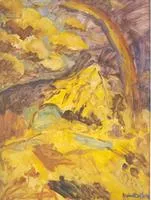
Image: Rainbow in Riwaka, 1977Courtesy of Dominion Post 2005-01-28
Being Frank
By Mark Amery
"They are so different from the contrived entertainment (no matter how good) of professional writers," remarked the late, great painter Sir Toss Woollaston of the letters of his foremost inspiration, Paul Cezanne. "He had his eye on the aim, not on the performance."
I think much the same of Woollaston's, collected in Toss Woollaston: A Life in Letters (Te Papa Press), and accompanied by editor Jill Trevelyan's lucid and engaging, sensitive and scholarly contextual notes.
Image: Rainbow in Riwaka, 1977As early as his 30s, Toss Woollaston (1910-1998) was piecing together an autobiography in letters to his new wife Edith. A vivacious writer - "I'm sitting in my car at Pioneer Motors while its being greased," he writes at one stage - Woollaston wrote as he painted, with passion and dedication as an essential part of living, always striving to do better. Part poet and preacher, his letters are marked by the clarity and dcandour of his thoughts, and their charming, often cheeky joie de vivre.
While some of Woollaston's early letters to Edith were to form the beginnings of his autobiography Sage Tea (Collins1980) that book concluded with the author aged 26, about to embark on both marriage and his career as an artist. For all Woollaston's belief in frankness, this conveniently sidestepped addressing the complexities of Woollaston's adult relationships, both personal and professional, in public - the very things that make A Life in Letters the juiciest of New Zealand art books I've read. Living in Nelson and travel away from home saw written correspondence form an important part of Woollaston's ongoing relationships with friends, colleagues and family.
Woollaston's liberal attitudes regarding sex developed in contrast to the strict Anglican values of his parents. This is the conflict that drives Sage Tea - sage tea being a concoction his mother made him drink as "a weapon of warfare" in service of chastity. Prior to marriage Woollaston had a long relationship with a man, Rodney Kennedy and extra marital affairs with men and women continued into his 70s (with the then American Ambassador no less).
For all of its intimate detail, it's primarily the struggle to be a professional artist that drives A Life in Letters, and Trevelyan's selection. A man of both singular vision and determination, Woollaston from an early age loathed the use of the word 'hobby' when it came to painting, and was radical for such a preferred career choice in the small communities he lived within. It wasn't until the 1960s, when he was in his 50s, that he was able financially to devote himself full-time to his art, the decades preceding this a long journey to realise this dream.
The book is illuminating in understanding the growth of professionalism in the visual arts in New Zealand last century or, more to the point, the lack thereof. Particularly the antagonism a modern painter like Woollaston faced in Nelson and Greymouth within the art world and public alike. You read him undertaking in the 1960s the very same battles he fought some 30 years earlier.
While generous in his support of fellow artists of real vision he's even quicker to comment on charlatans; artists who produce "empty showy exercises in other people's ways." Unfashionable for most of his life, Woollaston could be critical of other artists, often friends, with pinpoint accuracy. This is refreshing in an industry today stuffed full of art writing that too often uses words to dance around being critical.
"Julian Royds is awful, Doris's Hawera is a prententious failure, Russell's Maori looks like a solidified Goldie. Olivia's is the least terrible," Woollaston writes to Landfall editor and friend Charles Brasch of a selection of images in the magazine.
Woollaston here writes with strong, plain insightfulness about the creative process, it's day-to-day struggles, his doubts in himself as an artist, and the intensity of his interest in the work of other artists. A Life in Letters should be prescribed art school reading.
The publication of this book has been accompanied by a small exhibition in Te Papa's Illot Room until February 28, Woollaston: Family and Friends. Featuring small paintings and drawings of friends and relatives, and associated work from his early years, I came out unsure what the exhibition had of itself to say.
This is a collection of interesting fragments for the dedicated art follower: an affectionate portrait of Kennedy, showing the painter's burgeoning interest in the modern German painters and Picasso; a drawing of his mother, all wirey and stern (which graced the cover of Sage Tea); his father's head, sculpted on the page, as leaden and dull as a lump of coal. The exhibition neither provides a strong impression of the power of Woollaston the artist (for this, see two magnificent works in the Toi Te Papa exhibition), or what drove him at this crucial age. Far more useful would have been an exhibition that puts Woollaston's art (rather than life) in the context of the work of the artists, both heroes and colleagues who inspired him over his career.
What the exhibition does reveal is something special of the artist's sitters. While Woollaston once professed that he wanted to "paint no smiles or flashing looks, only the planes and lines of the object" he demonstrates an uncanny knack for capturing something in line of the essence of people in unguarded moments. These portraits may often seem unflattering in their severity but, as in Woollaston's letters, their directness is offset by the warmth of affection and humour