Behind the Scene
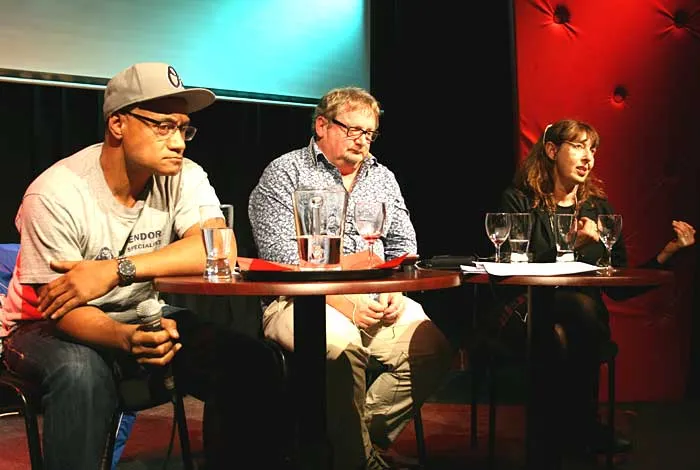
Two of New Zealand’s most experienced and acclaimed screenwriters, Rachel Lang and James Griffin joined writer/actor and Writer’s Room MC Oscar Kightley for an informal workshop session to deconstruct selected scene sequences from their hit show Outrageous Fortune.
This Script to Screen Writer's Room summary offers insights into the craft of constructing and writing scenes to create compelling drama.
* * *
Rachel and James have created, written and executive produced Outrageous Fortune, The Almighty Johnsons and the upcoming series The Blue Rose. Rachel also created Nothing Trivial, This is Not My Life and Go Girls (with writing partner Gavin Strawhan) and James paired up with Oscar to bring us Sione’s Wedding.
With so much collective experience on the stage, it seemed fitting for Oscar to begin by asking if the writing of scenes ever gets any easier.
“Yes and no,” replied Rachel. “Some scenes are almost ingrained now, for example what I call the ‘reversal scene’ where someone goes into it and says ‘I am never going to do this’ and then does it anyway. While working on soaps I learned there’s a basic scene structure which is the opposite of what I was taught in journalism. In drama you start with the least important and move to the most important because the end is a turning point for the scene. It’s important to remember that scenes are like building blocks, in a sequence, and are there to do certain things.”
The audience received copies of the selected scenes and two of these sequences were viewed and discussed during the evening. The first featured characters Van and Aurora meeting within the kitchen of the Horsemen motorcycle gang headquarters, an encounter James and Rachel likened to Van ‘storming the castle’, posing as a pizza delivery man, to rescue his princess. James and Rachel shared some of their writing tips.
“As a writer of dialogue within a scene,” said James, “the important things to remember are ‘pressure and release’. There’s an internal pressure within the scene. You want these two people to get together but they cannot and using humour is a good way to release the pressure.”
Most people don’t say what they really mean, or indeed tell the truth, in everyday conversation, an important point to remember when creating dialogue. “It’s more interesting for the audience to divine the truth of the scene through what the characters are not saying rather than spell it out for them,” said Rachel. “Let the audience do the work – that’s the most satisfying way to play a scene.”
And what about the classic requirement of a ‘three act structure’ within a scene sequence? “This sequence does have a three act structure,” said Rachel, “but I think it’s important to analyse that after you’ve written something and not before because the bottom line is always, ‘does it work?’ and I think you have a feeling when something works and when it doesn’t. There are three acts in this sequence: Van walks into the headquarters and we want to know: ‘Will he succeed?’ Then there’s the development: ‘Is he going to succeed?’ and then the complication” ‘Will Aurora talk to him?”
James said much can be said about structure within the context of a scene but the structure is best determined by being true to your characters. “We could have ended that sequence with Van getting back into the van and saying, “I’m going to win her back!” but that’s not him. He is crushed and wants to go get wasted. One of the rules for me as writer is not to overstay my welcome – get in and get out at the earliest possible moment. You want the audience to be doing the work for you at the end of the scene and so invest the audience with something to hang onto, something that is unfinished. Even though the next scene is one of resolution, there’s still so much left hanging – and that is good drama.”
… and never say what you’re going to do in the next scene. “That’s my rule,” said Rachel. “If someone says they are going to do something then it should never happen. Never say what you’re going to do in the next scene – plans should always go wrong or become complicated.”
When asked how important collaboration was in the writing of the scenes, Rachel said, “That was one storyline we all worked on. Write on your own if you must but if you want to write for TV then use other people. It’s the best thing in the world because you have instant response, more ideas and better criticism. We don’t always like it but the results are great and often joyful so it’s good to do it.”
Both James and Rachel agreed that absolute belief in the characters you create can override a tendency towards cliche in dialogue. “I try to look for different ways of saying the same old thing,” said James and Rachel added, “A mistake writers can make is to put themselves outside of their characters and judge them. If you are inside them you will be surprised by what comes out. Characters will say something surprising to me and that will bust the cliche. The scene we watched with Van and Aurora could have been cliched and nasty but because it was Van and the type of character he is, and Aurora, their past and the low rent-ness of it, the scene had danger and charm and it was specific to us in New Zealand. It annoys me when I read a script and realise the writer is regurgitating something they’ve seen. Root yourself in your characters and your work will be more interesting and joyful.”
Oscar asked the panel to outline how important setting and location was for them when writing a scene.
“Very important,” said James. “In the scene we watched, the first thing you establish is there’s a big fence with barbed wire so you know it’s going to be hard for Van to do his job.”
Rachel said while it is necessary to give details of the setting, try to restrict descriptions to the vital points. “We knew when we were writing the scene that we wanted a fortress but didn’t know the location. Don’t write a novel – and remember that some location person will have to go out and find that place for you so your writing instructions should be practical and specific without being prescriptive. Less is best. It’s more about the feeling you want from the scene and so from the location. Be very clear about what is important in the scene and what is going to make that scene live so don’t waste time on unnecessary detail. You’re not a novelist. You’re an emotional architect, building a set of instructions for others to follow.”
When asked about their writing process, James admitted that he rewrites scenes many times and the scene with Aurora and Van would have had about four drafts. “I don’t write in order off the storyline either. I write bits and then get into the flow of it. The first draft is the ‘swill’ draft. The battle is to keep hold of what made the scene interesting in the first place.”
Rachel confessed to being quite ‘swotty’, “… I always try to write what I want to but I go back and refine over and over. There is just no substitute for editing your own work. Sometimes I find it helpful to write the draft, walk away for a couple of weeks and then come back to it.”
The next scene sequence for discussion featured Loretta and Van after the death of Aurora. The writers decided to ‘attack grief’ and a number of episodes dealt with the aftermath of Aurora’s demise. The sequence was taken from the episode where Van’s grief is so unbearable that he decides to kill himself. The audience is aware of this and of Loretta’s pregnancy and the sequence revealed the emotional culmination of these two storylines.
“It’s a reversal of expectation because we really believe Van is going to kill himself,” said Rachel. “This is the other thing about drama. It gives you what you want but not in the way you wanted it. We don’t want Van to kill himself and when we see that Loretta is wrong in her belief that he will, it is a huge relief for the audience. And to see Loretta display so much emotion and actually cry is a big moment as she is the least emotional character on the show. This sets up a whole lot of other things too. When she says in this scene that she’ll have the baby, she really means it. We don’t know until later on that she plans to sell it but at that moment, she’s completely real and not thinking about selling the baby. Outrageous Fortune had the overarching theme that ‘what is legal is not necessarily moral’ and vice versa and scenes like this one can express supporting themes and ideas.”
James said this scene provides a good example of how characters must be put under pressure before they give voice to a decision. “Try to diminish the truth to character level. It’s boring if decisions come out too easily. Loretta is backed into a corner. She knows Van is not going to kill himself but she has made a huge emotional investment and these two things combined crack her resolve and she makes her decision.”
And the old adage about ‘show, don’t tell’ and writing to a subtext is well illustrated in the scene. “Loretta and Van don’t say ‘I love you’ in the scene,” said Rachel, “but you can see as brother and sister they are absolutely committed to each other.”
Characters under pressure create satisfying scenes for an audience. “There is suspense because the audience knows what Van is up to but the other characters don’t,” said Rachel, “so we are excited when another character gets it too and both characters embark on a new path after this. Scenes are about emotional intent and decisions, and as writers we can control these things. If you want to write as a director, that’s different. I am opposed to writers who might write, ‘she looks at her feet’. What does that mean? Just say, ‘she is angry’ and trust the actors. Most good actors will work out something more interesting than you ever could. Sometimes it’s good to give them business to do in a scene but be clear about the emotional intention, have an idea about the location and setting but remember it’s not your job to know all the specifics.”
Characters in Outrageous Fortune sound true and little of the writers’ voices can be heard. “Let the characters speak,” said Rachel. “I think you can hear the writer in some characters more than others and don’t be afraid to be stupid sometimes. Van is an example of a stupid character who expresses great wisdom.”
“Make the dialogue sound real,” said James,” and you are pulling off a great magic act. All dialogue is an approximation of a reality as filtered through that character and then put into a television box so it is a magic trick and it comes back to being true to your characters. Leave the real world, create one for your characters and inhabit it with them.”
Rachel said the analytical part of the writer’s mind can provide a necessary balance. “You can’t just let the characters run free in a scene. As a writer you need to control the traffic and follow a story but it has to appear effortless. It’s rather like a schizophrenic magic trick where you inhabit your characters but then go back to make sure you’re not so outside of them that you may as well be a director.”
Both admitted they go through the same emotions as their characters when writing. “I regularly sob at my computer when I’m writing,” said Rachel and James said there is a scene in the Christmas special, “… that reduces me to tears every time.”
At question time, the panel was asked to offer opinions about film directors who are becoming more involved with television production.
Rachel felt that most good television is writer driven. “You will get a series with a director’s name attached but there will be a strong writer/producer involved too. Most American TV is driven by a writer/producer.” James said he was glad to see the ‘snobbery’ between film and television breaking down. “Much of the best creative work is now being done on television features.”
Television does have some advantages over feature film. “The great thing for me about television,” said Rachel, “is I can work with a character for 108 hours in a series and explore where that character might go, unlike a film. If you have a strong premise and stay excited and surprised about where your characters are heading, you can go for a long time and that’s great fun for a writer. But in a film you have to hit the ground running and much of it is going to be about great pictures. A feature film may be amazing … but then it is over.”
When asked about the theme of Outrageous Fortune, Rachel said, “It was lurking as soon as the premise was made up and that was a woman who decides her family should go straight and they weren’t very happy about that. The lawyer who was the least moral person in the show, the ditzy model was actually a nice person and the dumb criminal had a great heart … this was always inherent in the characters and there from the start. I felt NZ drama needed to be really in your face. Scenes need to have oppositional characters, not a fight in every scene but very strong points of view and differences that will give you great drama and potentially, great comedy.”
- Event Summary: ‘Behind the Scene’, Auckland Writer’s Room, 29th May 2012 written for Script to Screen by Jane Bissell