Before and After Tarawera - George D Valentine at the National Library Gallery
Written by
George D Valentine - Courtesy of the Dominion Post - 06-05-2005
By Mark Amery
In this age of the digital image, of cut and crop until artistic satisfaction, we return to the past to award posthumous gongs to photographers who with hindsight we see as pioneers in the artform. Photographers we judged primarily on documentary value are rediscovered in a contemporary context for their aesthetic value.
Such it is with Mr George D Valentine of Dundee and his photographs of the New Zealand landscape...
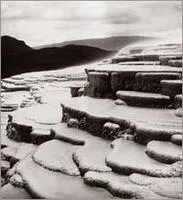
Image: Coffee Cups, White Terrace
1885 by George D. Valentine.George D Valentine - Courtesy of the Dominion Post - 06-05-2005
By Mark Amery
In this age of the digital image, of cut and crop until artistic satisfaction, we return to the past to award posthumous gongs to photographers who with hindsight we see as pioneers in the artform. Photographers we judged primarily on documentary value are rediscovered in a contemporary context for their aesthetic value.
Such it is with Mr George D Valentine of Dundee and his photographs of the New Zealand landscape...
Image: Coffee Cups, White Terrace
1885 by George D. Valentine.the subject of a touring exhibition from the Christchurch Art Gallery, currently showing at the National Library. The exhibition and accompanying book by Ken Hall are a major effort to assert Valentine in our history as a significant photographer.
Valentine's work was certainly admired in its day, but not with the same significance attached to its strong, distinctive compositions, and its expressive, almost abstract attention to rhythm and tone in forms in the landscape. These elements combine to create even in the most typical images of New Zealand (waterfalls and bush scenes from the Waitakere ranges for example) an expressive play with light which can create otherworldly dreamscapes. Images that take the viewer into the picture and the mind's eye, rather than (as we might expect from this period) an encouragement to step back and admire the view.
Valentine was one of three sons of Scotsman James Valentine, a pioneer photographer who founded one of the largest photographic publishing enterprises in the world, gaining royal commissions and particular renown for their landscapes. Collecting scenic views for the Scottish tourist market, George became a co-director of Valentine and Sons in 1879. They were said to have printed as many as 3000 landscape prints per day.
In 1883 however George contracted tuberculosis and shifted to New Zealand with his family in search of a more sympathetic climate. He was to live in New Zealand for only six years before his untimely death in 1890. In that time Valentine photographed the famed Pink and White Terraces of Lake Rotomahana - by then one of the adventurous English tourist's ultimate destinations. Even more crucially however he returned to the area to document the terrible aftermath of the Mount Tarawera eruption.
It is this significant body of work for which Valentine has been most valued, providing arguably the finest photographic record of both before and after the eruption, and this forms the main body of the exhibition.
While the exhibition provides plenty of documentary curiosity in terms of the wonders of these 'steps to heaven' (as one visitor called the Terraces) and the awesome devastation of the explosion, it's an appreciation of something other in some of Valentine's photographs that really holds me. He often steps in close to appreciate the plasticity of the strange forms as abstract wonders and, with their distinctive, assymetrical compositions, create sites full of explosive psychic potential.
In pre-explosion images like 'Coffee Cups' and 'Giant Buttress' the terraces are like wedding cake tiers, brimming with milky promise, their strong rhythmic compositions and the gorgeous rich tonal plays between light and dark able to take you into a fantastical realm. This dream is then shattered by nightmarish expressions post-explosion in the abstract. While in some images you can feel an apocalyptic silence and alienation in the camera's involvement with the lunar landscape-like surfaces, a number of others capture the firework action of geysers with a closeness that is far from comfortable, yet captivates with the beauty of the spraying plumage. In Valentine's work we often lose perspective on our own scale in relation to the subject. Our viewing platform is removed. This leaves a stunning image like 'Pohutu Geyser' with its darkness and ferocity in the abstract frightening in its portentous power.
When human figures do appear in this landscape they often serve to anchor and balance the rest of the image. In an extraordinary photograph of the Guide Sophie, her black and white cloak balances the strong shapes in the landscape in a way that makes us wonder whether it was something aesthetic that attracted Valentine to create the portrait in the first place. In the now celebrated 'Mount Tarawera and Ruawahia From Te Ariki' the strong-tiered diagonals in the work are brought strongly into play within the barren landscape by a man fending off at an opposing diagonal with his oar in a whale boat keeling to one side. This play between line and subject is a masterful expression of a world compacted and off kilter, the balanced grace of the human presence serving to echo the landscape's loneliness.
Having discovered Valentine's work, curator Ken Hall has been determined to bring his significance to light, and this is the first time a body of his work has been brought together. That fervour comes through sometimes with perhaps not quite the ideal amount of critical distance from his subject. Hall carefully presents the work to establish Valentine's reputation in a way that distances it from the commercial scenic photography of the day, even though this was such a fundamental part of his practise. I longed to see these images in context with Valentine's earlier work, and was surprised at the omission of strong work like that of the Waitomo Caves which is devoted space in Hall's book.
Hall is not helped by the exhibition's presentation in Wellington. When I first saw the exhibition at the Christchurch Art Gallery I was stunned, and the space devoted to the exhibition and the way it was lit encouraged an appreciation of these prints as artworks. Here the framed prints appear smaller, presented in a way that encourages you to pass over them quicker for their historic data. Stepping forward to get absorbed in the unexpected sophistication of Valentine's compositions is encouraged.
George D Valentine, National Library Gallery, until July 3