Beauty in the Base
Written by
Shannon Reed and Mark Henley find a pure poetry in the materials we construct walls around ourselves with, writes Mark Amery.
* * *
The first thing you notice is an industrial hum, cutting through the domestic cosiness the small rooms of 30 Upstairs otherwise provide. I could be at the dentist over the road.
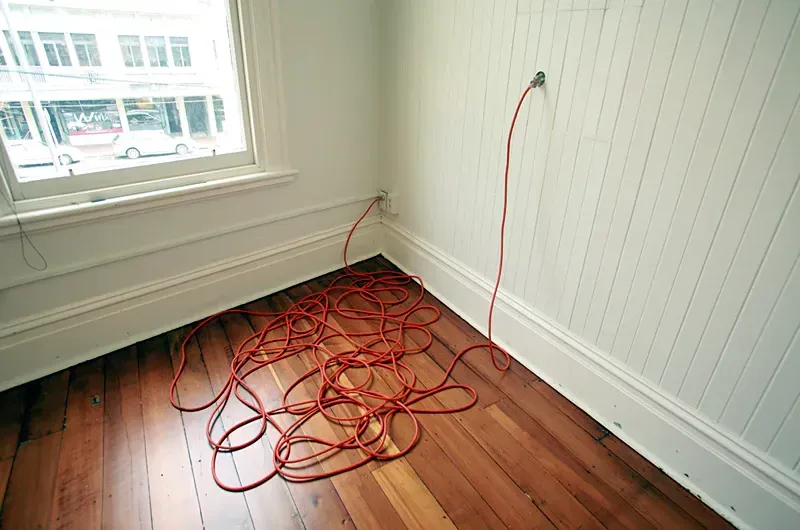
The sound emanates from where, in one room a coil of orange extension cord snakes from a power point up into a hole in the wall. Contained within is a radio receiver transmitting no content, just atmosphere. It’s as if the room’s collected electrical charge from years of use has become a vibration. As if, like a spiritualist, I find myself tuning into the space itself, only to find I have just become uncomfortably aware of the space’s many wires, light fittings, electrical and phone outlets.
The work is by Shannon Reed, pairing in the next door rooms with Mark Henley, fellow co-founder of Wellington artist collective Russian Frost Farmers. They have worked in different cities a world apart for many years but always in dialogue, something that’s clear here in some shared communalities of approach.
Other works of Reed’s are similarly hard, base and minimalist in their use of industrial material. They are experiments in the abstract, as if attempting to find some fundamental knowledge in material we employ around us. They make you reflect back on yourself.
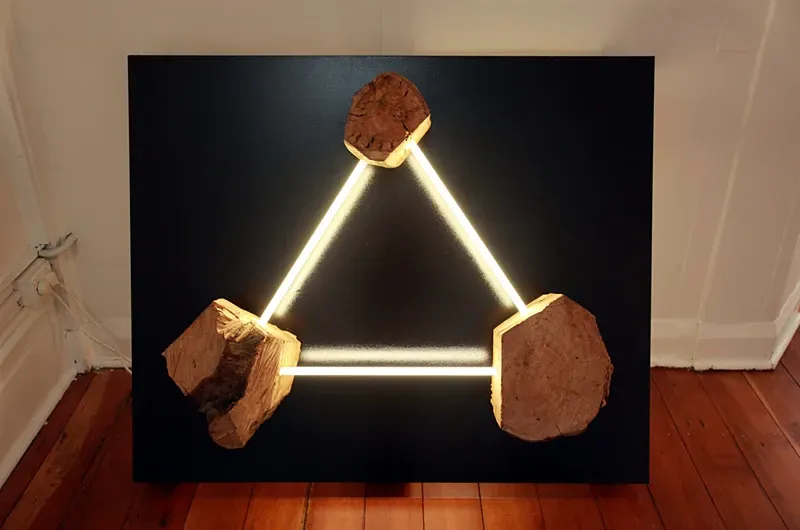
Another room is empty but for a sheet of large plywood within which a cut-out circle of plywood slowly rotates. It’s like a grandfather clock wiped of any features. In another, a live eco bulb is half embedded into a concrete block, as if over time its florescent glow might affect its surroundings. In the hall florescent tubes form a triangular circuit of energy intersecting three pine chopping blocks mounted on a pallet. The work operates like some Masonic symbol, advocating for belief in the virtues of the certainty of the materials around us.
Reed refines things back to an essential poetics. Bypassing emotional expression, there is still a human search for reason. The works have a kinetic charge that finds mystery in the banal, a beauty in simple, basic relationships. ‘Truth from materials’ was a maxim of modernist sculptors and architects, and its applied here in a fresh way.
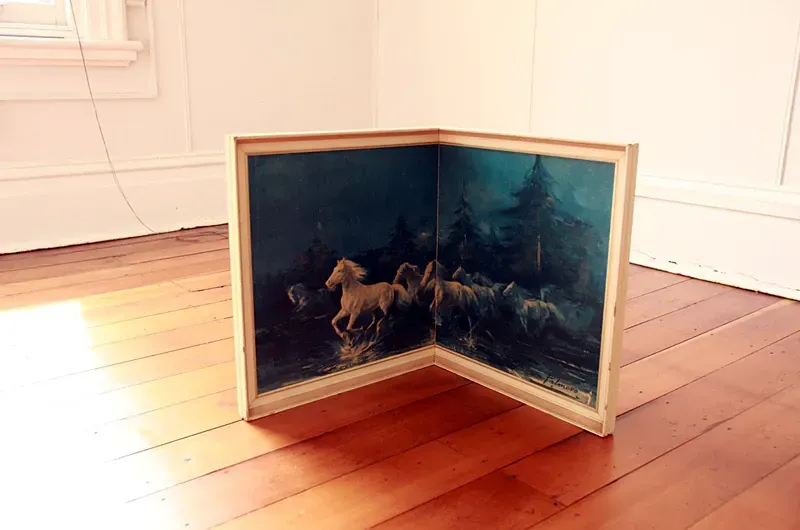
While the intellectual sternness that both Reed and Henley’s work sometimes put up bores me (and the badly written intellectualism that accompanies the exhibition doesn’t help) there is a fresh elegance. The work is enlivened by a gentle, smart humour: Wild Horses is a found second hand painting of white horses cut in half and put back together hinged, like a 70's double album. Big Bag is a large plastic bag hanging on the wall, in its bottom a section of rope soaked in a gradation of bright colours. It’s like a contemporary poor material bricolage version of a minimalist painting.
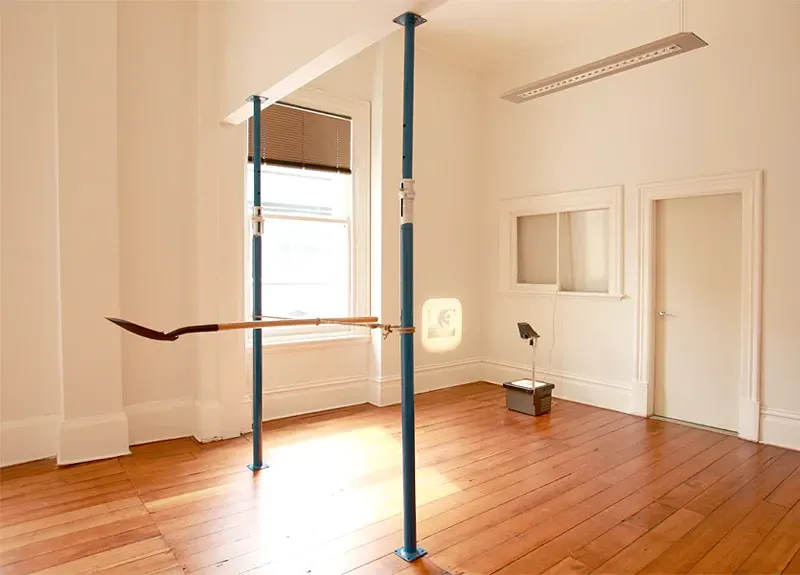
The work by Henley is less consistent as a grouping. Installation Herculean Effort provides a strong centerpiece, setting up a dynamic of tensions in relationship to the building. Steel rods appear to be holding up the roof and between these a spade is held in kinetic tension within a heavily twisted rope, as if set up to dig. It is absurd yet evocative.
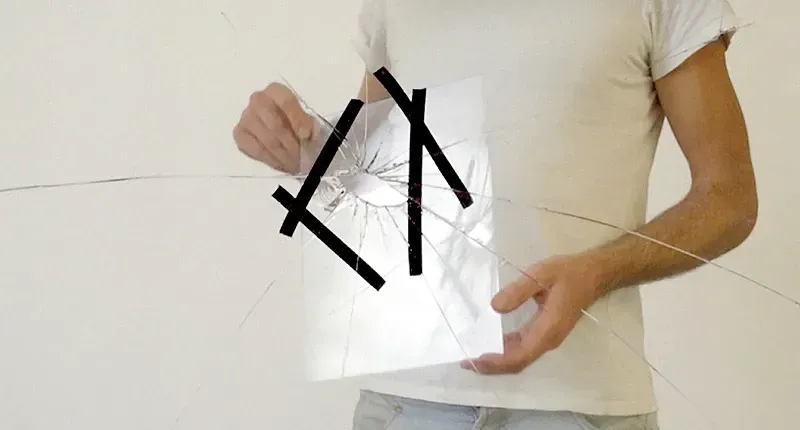
My favourite is a video. In Cold Reading – Composition #1 the artist slowly, temporarily repairs a break in a piece of glass that separates himself from us the viewer. Applying tape, sticky putty and glass, Henley creates both an appealing minimalist image using everyday materials, and an action wide open to our interpretation. For me it was a powerful emblem of our current relationship with the environment around us. How no temporary fix-its are going to work - we’re going to have to afford to replace the whole pane of glass.
- No Islands, Shannon Reed and Mark Henley, 30 Upstairs, until 27 October
- DON’T MISS
Robinson’s career has seen dramatic visual changes but this may be the boldest – as if stumbling around a carpet warehouse the floor and walls are taken over by totemic-like rolls of felt that echo indigenous artefacts, measuring systems and minimalist painting.
Defunct Mnemonics, Peter Robinson, Peter Mcleavey Gallery, until 27 October