Art that asks you to make political statements
Written by
By Mark Amery Courtesy of The Dominion Post
One of my favourite art experiences this year has been visiting a space that at first glance appeared to contain no art. Upstairs at Gambia Castle in Auckland's K Road was Tao Wells' Three Ideas for the State, an exhibition that consisted materially of three white A4 sheets placed on three white walls, echoing the gallery's three sash windows. In pencil were written three polite proposals by Wells for the betterment of society (also to be found in the current issue of magazine White Fungus). By Mark Amery Courtesy of The Dominion Post
One of my favourite art experiences this year has been visiting a space that at first glance appeared to contain no art. Upstairs at Gambia Castle in Auckland's K Road was Tao Wells' Three Ideas for the State, an exhibition that consisted materially of three white A4 sheets placed on three white walls, echoing the gallery's three sash windows. In pencil were written three polite proposals by Wells for the betterment of society (also to be found in the current issue of magazine White Fungus).The ideas were decent and achievable, but so scattershot as to question whether Wells had any real political motives at all. There was the promotion of equal space for bicycles on roads, flags for local iwi on community flagpoles, and regional aboriginal greetings on Australian television news. The clinch was that Wells put a price on putting these ideas into motion on your behalf as buyer. You could for example fund Wells to go to court with legal aid on behalf of an injured cyclist to test our cyclists' equal rights.
I'd been drawn to the exhibition by a lively exchange online between critic John Hurrell and Wells (at www.eyecontactartforum.blogspot.com), where Hurrell questioned the gallery as the best site for making these proposals when so many more direct methods for individuals are now available.
This missed the point. For me Wells was neatly putting up to question the social function of the contemporary gallery space, the political role of the artist and the conflicting value placed on an art object's sale. Not only that, in an age of information overload this quiet use of the gallery with pencil gave ideas room to breathe. Then there was the question of Wells' motives. Hurrell suggested he was more interested in impressing the art crowd than doing good. Well, exactly - it was this conflict that made the work so memorable.
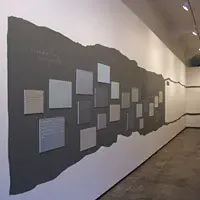
Now there's Fiona Jack's General Assembly. In a Wellington dealer gallery you can purchase an extract from the preamble to the United Nations' 2007 Declaration of Indigenous Rights. The extracts are painted copies from the handwriting of people worldwide who live in countries that refused to sign the declaration. Alternatively, you can choose to write up an article from the declaration yourself on the wall.
Jack's work responds to the fact that so few New Zealanders she has spoken to have realised that this country was one of only four of the 143 UN member states that refused to sign the declaration. She creates a social space where the gallery, with its copies of articles articulating different positions on the declaration, becomes a place for discussion and individual empowerment.
Our representative to the UN stated that New Zealand wished to disassociate itself from the text. While Jack's work doesn't explicitly express anger at New Zealand's position over the declaration, by asking individual's to absorb the provisions by writing them out she asks us, one by one, to reverse the action of collective disassociation. Decisions are personal, and since last year Canada has signed the declaration and Australia have indicated they will follow. That leaves only New Zealand and the United States.
Would Jack have been better to have set up a website to promote better understanding? I think not. The fact that you're reading this suggests there's good mileage to be gained by using a gallery space to raise complex issues.
The work also promotes personal participation as key to understanding. Putting one's own hand to a text means taking responsibility for the complexity of the issues. Take Chief Executive of Te Papa Seddon Bennington who, rather appropriately, selected an article concerning cultural heritage. Like some other scribes, Bennington chose to underline and highlight certain words, adding individual emphases. Politics are shown to begin with personal expression.
There is much that is rewarding about this work, but I find its dealer gallery context troublesome. Jack's visual framing of the words on the wall feels frilly, as does the act of selling painted renditions of others' handwriting - as if Jack had to do something to earn her keep. Selling off pieces as if they were chunks of the Berlin wall, it drew me back to the questions Tao Wells' work raised.
Image: Courtesy of the artist and Mary Newton Gallery
28/08/08