Art out to Pasture
Written by
By Mark Amery
A quick flick through a history of New Zealand painting will throw up one surprising omission – sheep. It’s as if the landscape has been shorn of signs of its economic base.
Or that a sprinkling of shaggy white fleeces and stubbly legs might mar green rolling colour fields, and detract from the Romantic isolation of craggy tops or run down sheds. That they might generally get in the way of a religiosity that, as McCahon quipped, provides “a landscape with too few lovers”. Our munching bovine friends would probably disagree.
I didn’t hold much hope then for Pataka’s group exhibition Sheep – NZ Icons in Art. Its title and stated aim of “celebrating the contribution that sheep have made to this nation's development” didn’t help, suggesting little more than the jingoistic postcard shot of a new born lamb sniffing a Spring daffodil and a Peter McIntyre-era rural idyll.
The exhibition however turns out to be far more interesting and rewarding. Our complex relationship to these animals can’t help but pull you in. Focus in at close range on the intense stare of a sheep and dark clouds start to crowd in, as Jonathan King’s film Black Sheep made much of. Contemporary artists have increasingly looked recently to the sheep as a symbol for a human complexion of objectification, money and murder. All this leads you back to the awkward exhibition title. If sheep are, like the rather more endangered Kiwi a national icon, what today do they most symbolise?
While the exhibition’s framework seems set on promoting the importance of sheep farming to the national economy rather than exploring its less fortunate sides, it’s otherwise nice and tightly curated, leaving the artists and sheep to do most of the talking.
At its heart is what could be an intimate survey of some of the best contemporary New Zealand photography, with a role call of well-known photographers and strong lesser knowns. While painters have shied from the subject traditionally, for the photographer since the 1970s it’s been a fine symbol out on the road trip of our uneasy relationship to the land. Starting here with Marti Friedlander’s powerful ‘Eglinton Valley’, a flock appearing on the metal road out a cloud of dust staring us down. Together the photographs here take a full range of approaches to the subject, from Peter Peryer’s more formal study of penned sheep from above to the sinister mechanics of scientific trials that see the sheep obscured by buckets and apparatus in Wayne Barrar’s photograph.
Aaron Smale’s eloquent colour images of the Fielding Salesyards are notable for the grotesque yet elegant ballet of sheep leaping out of the gate at eye level, whilst their masters loom in the background. Anthony McKee takes a clever fenceline viewpoint to juxtapose the lot of sheep jampacked in on muddy ground next to that of a farmer’s tethered white horse looking coyly towards the camera in an open field. Jae Hoon Lee’s photocollage is a far more complex take on the sheep field than Brian Brake’s study here, repeating the folds of the land until they become those of a garment. It’s a cloth studded by sheep who, in an uneasy balance between the real and the artificial, look like they might have been photoshopped on.
Other mixed media and assemblage artists also provide some of the most powerful work here. Andrea Gardner’s mix of bucolic sublime background landscape and sheep left on muddy pillars in a devastated foreground, awaiting a muddy clod of an asteroid, is clever and unnerving. As is Brit Bunkley’s superb suite of animated video works. Echoing Gardner, one sees a lone silent sheep and a trio of businesspeople, chattering banally, in the foreground, while a beautiful landscape melts like Neapolitan icecream behind. Bunkley like Sean Crawford elsewhere makes links between agriculture and American militarisation under the nation’s skin.
Meanwhile, no sheep show could be complete without Gregor Kregar’s colourful cardy covered ceramic sheep. Here matched with video of the performance with actual penned sheep on Waiheke Island, it’s something of a letdown next to the brilliance of seeing the sheep in situ outside City Gallery in Civic Square a few years ago.
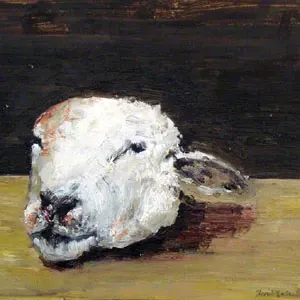
The paintings in the exhibition are a bit of a mixed bag and also emphasise how peripheral this subject has been treated, at least by public galleries. The under-recognised Trevor Moffit is here, as is Joanna Braithwaite with one of her eerie bloodied sheep’s heads from the early 1990s. I was also rather taken by the charcoal close-ups of lambs’ heads with flying pink ears by Kristin Hollins. With their heads divorced from their bodies against a black background, these young animals uncomfortably close gaze has all the innocent abandonment and beauty of a raving teenager at a dance party.
Sheep – NZ Icons in Art, Pataka, Porirua, until 23 January
Future of Sheep farming in NZ – forum, Sunday 14 November, 2pm, Pataka