Art and Motorways
Written by
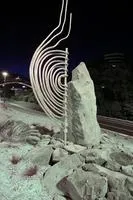
Caroline Robinson's most recent sculptural commission Maumahara mo Waiparuru -remembering ancient pathways was completed just before Christmas as part of the Auckland Grafton Gully freeflow project. We talk to her about art and motorways and the philosophy driving contemporary urban design.
Read on for interview....Caroline Robinson's most recent sculptural commission Maumahara mo Waiparuru -remembering ancient pathways was completed just before Christmas as part of the Auckland Grafton Gully freeflow project. We talk to her about art and motorways and the philosophy driving contemporary urban design.
Read on for interview....TBI: So what in your past has prepared you for a commission such as the Grafton Gully freeflow project?
Caroline Robinson: Probably the most significant preparation would have to be being raised on a farm in Taranaki and having a childhood filled with playing with sticks and stones, dirt and hay, horses and cows - living the rural life. Evolving out of that childhood I've been involved in the creative sector for 13 years spanning through fashion, performing arts, wearable arts, and in the last 5-6 years I've been into installation works. So there is a whole history for me of being involved in collaborative creative processes. In very recent years I've been mostly focused on the public realm, creating sculpture and environments, and working with communities, for example on urban design projects such as the ones initiated by Auckland City Council. This means being involved in processes where my work as an artist is part of a bigger story in terms of a design construction process.
TBI: So what's different about contemporary urban design projects now that we are getting such interesting results?
Caroline Robinson: It's a very, very exciting time right now in urban design. I think New Zealand like many places in the world is realising that to achieve powerful results we need the whole picture, which requires bringing together lots of different perspectives to create better solutions. So to have arts and design processes merging with traditional engineering and construction processes is becoming almost mainstream now. And ACC and other councils such as Waitakere are very committed to evolving processes whereby arts based skill is naturally included in decision-making processes in relation to city planning and urban design. So specifically in the last 2 years the Auckland City Council projects that I have been involved with are the redevelopment projects of the Glen Innes and Panmure town centres.
My role on the team has been part of drawing the story of the community and the land, working with the people so that those stories come right into the heart of the design process. I help to translate what the community is saying about what they see and experience in their place into the discussion that happens around the design table.
TBI:The history of public sculpture in Auckland is not a particularly happy one. Many works have disappeared. Jim Allen's work in Pakuranga Shopping Centre, the Japanese kinetic work in the former Downtown Plaza (apparently about to be re sited). Other works have just not entered the public imagination - the Signals work on Parnell Hill for one.
Caroline Robinson: One of the main reasons that I am doing public artwork is to be part of creating markers or signifiers of what's going on in our places and that has to refer to the past, the present and the future, so it has to have a relationship with the place. It is not about presenting a personal moment for me. It's about our collective story.
TBI:How did the freeflow project came about for you?
Caroline Robinson: As a result of engaging in informal conversations with freeflow, I was invited to talk further with them about what they were doing on the project. And so I was invited along with three other artists to express interest in a sculptural project for the Grafton Gully.
TBI:So what did you present?
Caroline Robinson: Because of the philosophy of my work I find it impossible to present a resolved concept of what I want to make without having done the research to learn about the area and the context. What I presented was a process that I wanted to go through in order to arrive at a concept. So I engaged freeflow and Transit NZ with the journey that I wanted to go on with them to create the work.
TBI:So what was that process?
Caroline Robinson:I set up a small concept development team which was made up of myself, Peter Turei of Ngai Tai and Ngarimu Blair of Ngati Whatua O Orakei. Together we explored the site and its wider context and shared stories of the history that we were each gathering. We talked through all sorts of ideas with each other and with others in the community. Out of that pool of knowledge and experience the concepts started to emerge. The gully has a very very rich history - the natural, cultural and social history. The native bush that was in the Gully was considered some of the most magnificent in the North Island. The cultural and social history of the gully is important to Tamaki Makaurau with a very very rich Maori history and it was the site for Auckland City's first cemetery. Most of that history is now invisible in the roading context. So our concept process became focused on addressing the depth and sensitivity of that history. I wanted to create a work that would give something back and that would address the memory of the place.
Being down under the old Grafton Bridge, which I consider one of the most dramatic structures in Auckland city - it was a very overwhelming feeling being there- even without knowing intellectually what had happened there, on my first visit I felt quite disturbed. I learnt later that it was where over 1000 bodies were pulled from the first cemetery during the 60s when the first motorway went through. It's also the place where many people have taken their lives off the bridge. I felt very humbled and had a great sense of responsibility to do something that was very sensitive to that history. The sculptural shape that came from this was a pathway of release, a gently lifting.
TBI:The work itself also addresses the waterway systems that used to flow through Grafton Gully -
Caroline Robinson:Our waterways are an important part of the story of both our natural and social histories. Waiparuru was the name of the stream that used to flow through there and it's now underground. It is the most obvious metaphor of what the sculpture is marking, the path and the memory of that stream.. The water is a vein of life that is nourishing and feeding the life there. Marking Waiparuru's path is a metaphor for remembering all the organic life from that area. Honouring the stream is also about honouring the memory that the water is carrying, the lives that have been lived and lost in its presence. It is a body of memory moving down the gully slowly meandering, out to the Waitemata. Carrying life and also carrying a release from life out to a larger body of water.
TBI:So how did that translate into a sculpture?
Caroline Robinson:One of the most interesting challenges that I found from a design point of view was the tension between the large scale of that physical environment of the motorway, and my need to address quite subtle, invisible influences in the landscape. The question is how do you translate that subtlety into a large scale artwork I ended up being most interested in creating something that carried the feeling of that place by working with a quietly energetic source.
TBI:So was this your first earthwork?
Caroline Robinson:Yes it was. In the concept design phase I discovered that there was a lot of excess clay as part of the motorway construction process that was going to have to be carried offsite at great cost to the project. At the same time they were also quarrying a lot of stone out of the Khyber Pass rockface that likewise was going to be carried off site at a cost to the project. I cottoned onto that and saw it as a fantastic opportunity to recycle the clay and the stone and make it part of the sculpture. So the availability of that resource became an informant to the direction of the design as it was perfect philosophically to work with the land so directly. I hand selected the smaller rocks out of the Kyber Pass quarry face and then 12 large basalt rocks, 6 of which came from Fulton Hogan's Mt Wellington Quarry. I spent about 3 months going to the Quarry almost weekly, and every time they did a blast, looking for the perfect rocks! The other 6 column rocks came via the stonemasons that I was working with, originally from near Whangarei.
TBI: So you worked with some of the freeflow designers, architects,
Caroline Robinson: Yes, the team at freeflow made this project happen. The whole freeflow design team were working on the site, including engineers,draughts people, and all the technical assistance that I needed. . I built a clay maquette at 1:100 scale and then the team translated it into construction drawings. So a good number of people were involved in the design phase, and helped enormously to bring the concepts to actuality.
So the same people on the diggers who were making the motorway also did the shaping of the sculpture itself.
We just took exactly the same team, and equipment who had made the roads and the bridges. It was the same materials for them, it was just another day at the office. It was just slightly different shapes we were making. The earthworks supervisor Andy said he thought this is something different and interesting, some curved lines instead of just straight roads! It was a buzz to crop up in each other's world for a few months, and we all enjoyed the exchange.
TBI:So it's the first time that an artwork in New Zealand has been commissioned in a large scale motorway project?
Caroline Robinson:As far as I know I think this is the first time that an artwork has been integrated into a large motorway project. The way the project was structured there was already a team environment set up which made it easy for me to enter the project and bring an arts perspective to the construction process.
The freeflow philosophy was about leaving a positive legacy. As Judith Tizard said on the opening day, the sculptures served to close the loop between the idea of the past and the history and these new construction processes. Here we are now - we have made these major changes to the Gully, but we are making an effort to remember where we have come from.
ENDS