Anna Miles on Maija Isola's Lokki patterns for curtains
Written by
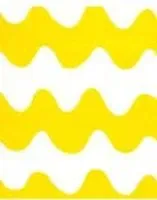
Lokki by Anna Miles
From the Talking About exhibition at Objectspace (until 3 December 2004)
To someone with an inordinate love of curtains, Maija Isola's Lokki is the pattern of the near perfect curtain. Imagine the pleasure of compressing these corrugations each morning and stretching them out each evening. Each pull, like Isola's pattern, pleasingly transforms that simplest decorative form, the stripe. Lokki by Anna Miles
From the Talking About exhibition at Objectspace (until 3 December 2004)
To someone with an inordinate love of curtains, Maija Isola's Lokki is the pattern of the near perfect curtain. Imagine the pleasure of compressing these corrugations each morning and stretching them out each evening. Each pull, like Isola's pattern, pleasingly transforms that simplest decorative form, the stripe.Released by Marimekko in 1961, Lokki belongs at an opposite end of the modernist trajectory to the metal lamps and teapots handmade at the Bauhaus to look as if made by machine. Isola's design displays its handmade character freely, yet as an object produced on another modernist cusp it has its affinities with these prototypes of the 1920s.
This crisp relic of 1960s Finland (unfortunately named after a seagull) has a paradoxical character. Only the cut paper stencil that forms the prototype or 'repeat' is actually handmade. At that moment when the squeegee sends ink through the screen, the repeat is repeated and Lokki is handmade no longer. For a short time the pattern was hand printed, but most of the extant kilometres are machine manufactured. From an aesthetic point of view the method of production makes little discernible difference. The handmade character of the loping line transfers to the textile surface with remarkable effectiveness.
Designing Lokki was an exercise in reduction. Isola discarded the photographic method utilised in her Luonto (nature) series of the late 1950s - a channelling of the spirit of early practitioners of the photogram that features lacy silhouettes of pressed plants like cow parsley reproduced at the scale of totara. Instead, she returned to the most fundamental screen print technology, the cut paper stencil. Taking a variation on the stripe or Sienese wave as her subject, she expended nothing more than enlargement and a single colour in her essay on the undulating gesture.
The character of Isola's cut is what makes it. Her scissor marks traverse the gap between restless and boring. An effortless grasp of form gives the pattern bounce, yet Lokki's hourglass rhythms are not difficult to live with. The interplay of concave and convex encourages daydreaming. By making imprecision a virtue you might think her line has its origins in Victorian England. The understanding of the handmade mark as unique and expressive dates to critics such as Ruskin, inflamed by the perceived dehumanising impact of industrialisation.
Somehow Lokki's expressive vocabulary reconciles a subsequent craft revival (of post-war rather than the nineteenth century) and 1960s psychedelia. These wasp waist-ish curves reach back to the old fashioned glamour of New Look Dior while anticipating the allure of pared-back minimalism. Lokki's greatest mystery however is its construction. Even tracing over Isola's design it is difficult to pick up the beginning and end of her pattern. This is partly because, contrary to the idea that the handmade is unique, Lokki's repeat is actually a repetition.
Only a sophisticated eye immersed in the technologies it works with could have seen and seized intrinsic qualities such as flatness, scale and repetition in this way. Isola's work makes her feel for the textile surface look intuitive. A ravishing pink and yellow variation on Lokki reveals her experience and knowledge of materials. The overlapping pink and yellow produces a vibrant orange lip. Her enthusiasm for the print medium includes interest in effects often dismissed as defects. In Putkinotko, the well known cow parsley design, visual interest comes from an approach that is close to mis-registration.
Lokki could be the textile demonstration of the Strunk and White maxim, 'Favour the plain over the fancy', except that it isn't. The handmade character of this design is decorative in the grand manner. Isola's drawing with scissors sets off a play of symmetry and asymmetry of the kind that has informed great gardens and fascinated designers of every civilisation. Yet it is difficult to imagine this design springing from any place other than 1960s Scandinavia. The closest twentieth century parallel are Popova and Stepanova's striking Russian Constructivist dress fabrics of the 1920s. Of these, Lesley Jackson has written, 'The chopping up and reassembling of geometric motifs presages the visual tricks of Op Art forty years later.' Yet these revolutionary designs, such as Stepanova's pattern based on a propeller, are grounded in an enthusiasm for the machine age and geometric order that is unrelated to Lokki's organic imprecision.
It is tempting to associate Isola with the optimism of these artists who saw a new decorative vocabulary in terms of radical social change. However, Marimekko's agenda was limited to transforming the bourgeois domestic sphere. While the audacious scale of Lokki connects it to the Russian patterns, its main effect is lightness. Like the regular repeat of Isola's irregular repeat, Lokki's largeness is fun.
Isola was a painter educated as a weaver. She studied at the Institute of Industrial Arts in Helsinki from 1946 to 1949, a period in which students specialised in woven rather than printed textiles. She regarded her primary interest as art. Her education probably differed little from that of women students at the Bauhaus a generation earlier. While the Weimar school was founded on the principle that no distinction should be made between fine arts and practical crafts, in practice this rarely meant admitting women students to areas other than the weaving workshop.
I have seen only a fraction of the 533 designs Isola produced for Marimekko over the course of her 38 year career, yet I wonder if Lokki is unusually absorbent. Its method of invention can be related to Matisse's cut outs of the 1950s while recollecting ephemeral decorative forms like bunting, streamers and simple paper cut scallops attached to shelves, walls and wooden beams. Isola is on record as interested in American abstraction. Presumably she would have been aware of the work of artists such as Robert Motherwell and Barnett Newman. On the other hand, her Ornamentti series of 1959 is based on traditional Slovakian embroidery and lace. The one colour on white scheme she favours has connections with the ticking stripes, simple woven runners and Delft tiled stoves found in Scandinavian homes like that of Swedish Arts and Crafts artist, Carl Larsen.
It is unlikely that the German folk tradition of Scherenschnitte or "scissor cutting" would have escaped Isola's attention. Dating from fourth or fifth century China, Scherenschnitte came to prominence during the romantic national phase of the late nineteenth century associated with the Arts and Crafts Movement. This homely combination of doily and silhouette was brought to America by immigrants from Southern Germany and Switzerland, and is well known in Pennsylvania. The Pittsburgh-raised screen printer, Andy Warhol, was probably familiar with Wycinanki, a Polish variation on this type of cut paper decoration.
Isola's pattern might be taken as a modernist example par excellence; exemplifying truth to materials, craft as a laboratory for design, and reductive abstraction. A contrary argument would make more of the design's joke-like playful elements. A punning sensibility is apparent in its details. The wave, a basic type repetition, is repeated. The under-and-over mimics the rhythm of the warp and weft of weaving. The repeat is in itself a repeat, and an irregular one at that. The scale play and striations reference Pop and Op. Lokki's reflexive qualities also remind me of a 1920s silk, delicately hand printed with tyre tread patterns as if it had been run over.
How being handmade has informed Lokki's design values is an eye-opening subject. Its spontaneity conveys a swerve away from modernism more felt than reasoned. Still, the design remains modern enough not to have lost the whiff of instruction. If Lokki is exemplary of anything, it is the way that making leads thinking. Isola's engagement with the messiness of materiality prompted unexpected thoughts and unpredictable results and shines out of this pattern.
Without fuss or drama Lokki demonstrates the meeting of art, craft and design. Tracing the backstory of Isola's pattern to the Bauhaus is easy. More fun is to trace it further via folksy scissor cutting to the nineteenth century design reformers who argued over ornamentation. What is paradoxical about Lokki is its beauty. Isola's mark has the rare grace of something that is neither overly expressive or mechanical; something not quite Ruskin and not quite Warhol. Playfully blown up larger than life, her stripe is a trip around that urge at the base of modernism: decoration.
Anna Miles established Anna Miles Gallery in November 2003. She teaches at the AUT School of Art and Design.
Lokki is reprinted from Talking About with the permission of Anna Miles and Objectspace.
Talking About was a project curated for Objectspace by Damian Skinner with contributors Don Basset, Richard Fahey, Bronwyn Fletcher, Moyra Elliott, Ngarino Ellis, Louis Le Vaillant & Rigel Sorzano, Sean Mallon, Anna Miles, Cushla Parekowhai, Elizabeth Rankin and Grant Thompson all of whom have selected an object and written about it.
17/11/04