AAF IV: Wu Man
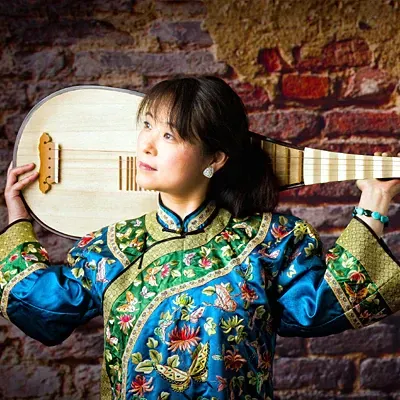
Grammy award nominee and Musical America's 2013 Instrumentalist of the Year, Wu Man, blends 2000 years of Chinese tradition with Western classical music in her playing of the pipa, or Chinese lute. Claire Cowan interviewed her ahead of her two Auckland Arts Festival appearances.
* * *
Wu Man plays the pipa, an instrument traditionally played by educated upper-class women. Like her courtly predecessors, she has used her skill on the pipa to perform a delicate feat of diplomacy – blending over 2000 years of Chinese music tradition with Western classical music. Born in Hangzhou, China, Wu Man has performed with major orchestras around the world, and collaborated with some of the world's leading composers, including Philip Glass, Tan Dun and Terry Riley, and performers the Silk Road Ensemble, Yo-Yo Ma and the Kronos Quartet.
Wu-man is performing in two special events at the Festival - A Chinese Home and Ghost Opera with the renowned Kronos Quartet on Saturday 9 March, and a solo performance on Sunday 10 March.
When did you first lay hands on a pipa and did you ever imagine it would become such an important aspect of your life?
I first picked up the pipa when I was 10. I always loved music but I think it was when I was 13 when I went to music school that I knew the pipa would be my life.
Was it pipa all the way or did you ever experiment with other instruments?
When I was nine I started to play a sort of mini pipa (also a traditional plucked instrument) called the liuqin. In music school I also played other traditional plucked instruments. In music school all students were required to play the piano, but the pipa was always my instrument. But if I needed to I could also play other instruments in ensembles as well.
The pipa has the longest history in China, and its music goes with a lot of poems and paintings. It’s one of the most important musical instruments in Chinese history, and because of that the pipa has a greater vocabulary and deeper music than other traditional instruments. That’s why I love pipa, and that’s why pipa attracted me.
What are some of the joys/difficulties of combining traditional/folk music with modern classical music?
To me there’s no big difference. Modern or traditional, it’s all music and it’s all an expression feelings. To me there’s just no difference; the styles just all the same. If music makes me happy, moved, or touched that’s all people want to enjoy that kind of music. Music is music. It’s all from different corners of the earth but it’s all music - even music from 100 years ago or 21st century music, it’s all music.
Have you ever played with traditional Maori instrumentalists? (Taonga Puoro)
No I have never played with Maori musicians in New Zealand but I’ve played with Australian didgeridoo. It was an amazing experience, but I would be very interested in the opportunity to play with Maori musicians.
What are some of the differences in approach for performers for traditional / folk performers compared with mainstream classical artists?
The Chinese folk music tradition is oral. That’s how they pass it down to generations. Most traditional folk music is the same. It’s an oral tradition with no music or score. Musically the spirit is quite free and involves improvisation. Musicians will also play on the spot, and it depends on the mode, the feelings, the situation…so they may play differently every time.
What's your Big Idea for 2013?
My musical journey has been to work with Aboriginal Singers from Taiwan and working with central Asian Uyghur musicians. I hope the next big idea is the opportunity to work with the Latin American plucked instrument family. I want Chinese traditional instruments to have conversations with Latin American instrumentalists, which hasn’t happened before. It would be a musical conversation between two cultures.
- The Auckland Arts Festival 2013 is on from 6 to 24 March