AAF IV: Felicity Simpson - Urban
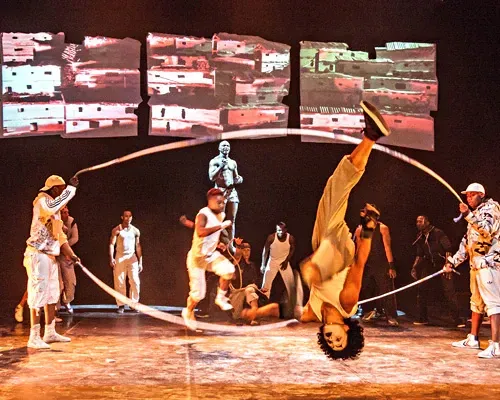
Urban, described as ‘revolutionary circus’, translates the gritty reality of life for its young Columbian performers into a circus show. Renee Liang speaks to director Felicity Simpson.
* * *
While Urban does indeed hail from a centre of revolution – Columbia – what is different about this show is not the circus acts, but the performers: youth from ‘at-risk’ backgrounds, nurtured in the physically demanding environment of a circus school, Circo Para Todos. The school is a collaboration between a UK circus performer, Felicity Simpson, and her Columbian partners, and has been emulated elsewhere in South America. Urban, originally commissioned for UK arts festivals, translates the gritty reality of life for these youth into a circus show – a telling metaphor if there ever was one.
I spoke to Felicity Simpson about the show and her work.
Why did you choose to be a circus performer?
I started in theatre and ran away to the circus to be less limited. I’ve been on the stage since the age of 12 (child parts in Opera, and also variety routine trained by parents)
How did you come to set up Circo Para Todos?
My Colombian work partner and I dreamed up the best possible school in dressing rooms. The idea was to set up the world’s first professional circus school specifically dedicated to youth from a difficult background.
Can you describe how you recruit and train these young people? Can anyone join?
No, social criteria is one of the first on the list, alongside motivation. Then physical aptitudes. To get a place in the school is very difficult. They start through community workshops and the most motivated can apply to audition at the pro school. It’s a four year course, free food, education, uniform and transport.
Has the Circo Para Todos model been copied elsewhere?
Yes, Brazil, South Africa, Chile and Argentina.
What does being on stage do for these young people?
Live from a profession they love.
What happens when these young people graduate from Circo Para Todos?
They go out onto the world’s stage.
Why is your style of circus 'revolutionary'?
Because it is human, raw, rough and real. You can see the strain, effort and really be in contact with the artist on stage. They are not playing roles, they are being themselves, they are irreplaceable.
Urban is described as gritty and autobiographical. How do you go about exploring what must be sensitive stories, for the stage?
Delicately and if the artist wants to share.
Do you and your cast have plans to connect with local youth while in NZ?
Hope so – that is one of the best encounters.
What are your next plans for Circolombia and Circo Para Todos ?
Tour Colombia, then back to continue the world tour. New show has been commissioned by the London Round House so research and development starts in September.
- The Auckland Arts Festival 2013 is on from 6 to 24 March