A public art presence
Written by
Along with a new annual SCAPE Public Art season in Christchurch is a new managing curator, Heather Galbraith, who is on board until 2018. Heather tells us about her creative career, the current exhibition Presence, brewing the next season, and the role of public art.
“Understandably people feel very passionately about what is developed in their urban environment, and this is amplified in Ōtautahi, where so much is still provisional, and people are concerned with how their voices can be heard and what the future of their city is going to be.
“In this context public art can offer a spectrum of experiences, from moments of escape and contemplation within a hectic and constantly transforming environment, to works that more directly address conditions of the city historically and now.”
What aspect of your creative practice gives you the biggest thrill?
When curatorial projects meet their audiences and responses and reactions to works become tangible. This can occur through a process of development (if participation or collaboration are factors in the work) or when works are revealed for exhibition. Up until that point things can feel hypothetical. Beyond that point they get very real indeed!
What's your number one tip for surviving (and thriving) in the creative industries?
Resilience and being in it for the long haul. No one project is going to fulfill all your dreams and desires. Foster in-depth relationships with artists and peers over time. These networks are crucial. Be generous with your time and experience but also be judicious, it is possible to burn out, to spread yourself so thin that you cease to be effective.
Tell us a bit about your background
I grew up on the North Shore, Auckland and had the benefit of a brilliant art education at Westlake Girls High School with teachers Sue McBride and Judy Darragh. Elam School of Fine Arts was a formative experience and set me up to head into the world, which I did as soon as I graduated, travelling through some cities in the US and then settling in London. My MA at Goldsmiths’ College totally shifted my entire frame of reference, and set me firmly on the path of curatorial practice. I cut my teeth working at Camden Arts Centre in London for seven years as Exhibitions Organiser.
The pull of Aotearoa and my family became too strong and I came back in 2004, to be inaugural Director/Curator of St Paul ST, at AUT University. Then to City Gallery Wellington as Senior Curator for five years, then Museum of New Zealand Te Papa Tongarewa for a short spell as Senior Curator Art, before joining the College of Creative Arts, Massey University Wellington where I was for four years as Head of School of Whiti o Rehua School of Art. I stepped down from that demanding role to deliver the 2015 New Zealand at the Venice Biennale project, Simon Denny: Secret Power, and to embark on a final round of IVF, which very fortunately resulted in a lively and curious wee girl, Winnie, who is making our life very full and rich and freakin’ hilarious at the moment. I am part-time at Massey University currently which has enabled me to take on the role of Managing Curator for SCAPE for 2016-2018.
When/why did you join the SCAPE team? What’s your connection with Christchurch?
I was approached by Deborah McCormick to express interest in the Managing Curator role in April of 2016. I was very close to saying no as life is full already with Massey University and parenting, but the possibility of working within the revised SCAPE annual structure, and having the chance to develop a longer relationship with the city of Ōtautahi and its peoples, was too enticing. The 2016 project was realised at high speed (we had four months to develop and deliver due to the transition to an annual programme for SCAPE), so I am very much looking forward to a more ‘slow cooked’ approach for 2017 and 2018. I have been visiting Christchurch since I returned to New Zealand to see exhibitions and work with colleagues there. Before and after the earthquakes I would be down three or more times a year connected with the Venice Biennale projects (in 2009 and 2013, Jenny Harper was Commissioner and I was Deputy Commissioner, and in 2015 I was Commissioner).
What does your role as Managing Curator for SCAPE include and who do you work with?
I am working on three group exhibitions in public space to take place each October/November in 2016, 2017 and 2018, plus three commissioned works, two to launch in 2017 and one in 2018. I work very closely with the SCAPE team led by Director Deborah McCormick, and also the SCAPE Curatorial Committee which includes Deborah, and Trustees artist Darryn George and Architectural Historian Jenny May. I have also had the pleasure of working with MFA student Aliyah Winter as a Research Assistant thanks to support through Massey University.
Tell us about Presence: the curated exhibition element of SCAPE and the Public Walkway?
Presence involves work by eight artists (around 30 individual works) located across 10 sites, which are a mixture of outdoor locations (such as the Kiosk Lake within the Botanical Gardens, Market Square and the quadrangle at Christ’s College) and indoor sites that are accessible (e.g. the refurbished Library within the Arts Centre, the Wynn Williams building, and the Casino). Some of the works relate to how traditions of figurative sculpture have emerged and are regarded in a contemporary context, riffing off Stay, the two works by British Senior artist Anthony Gormley. Other works are more abstract, but still have a relationship with the body and with understanding the ways we understand ‘presence’, being present, being visible, being in the moment, in times of turbulence and change. Other works explore more cosmological, spiritual and science fiction inferences of ‘presence’ and ‘absence’.
Tell us about your selection of artists/works/locations?
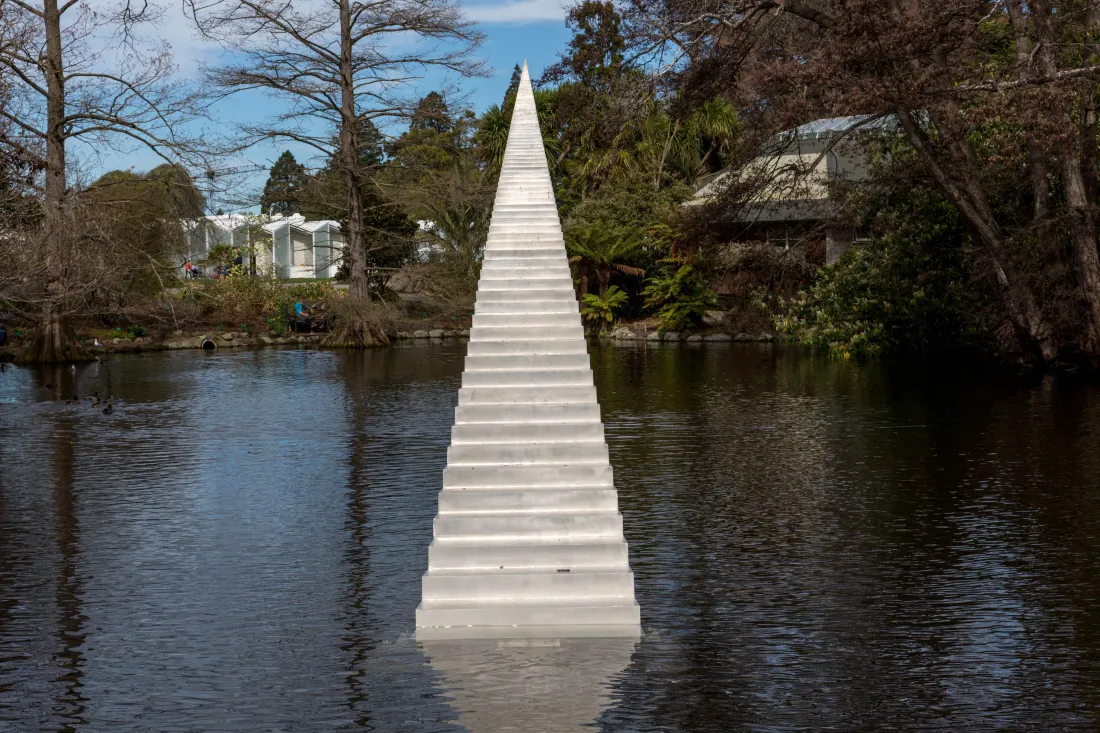
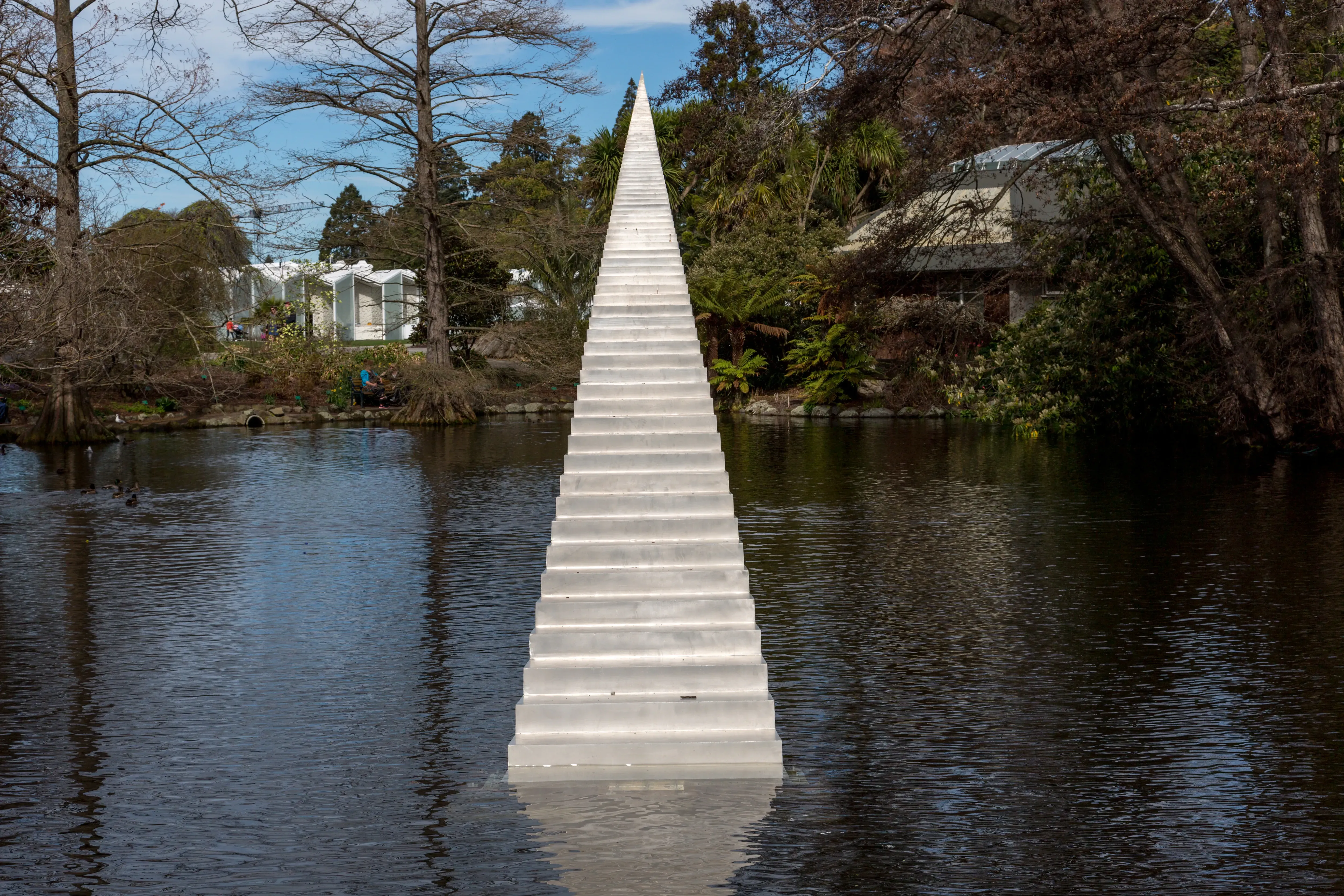
The sites were selected alongside the securing of works (as the time-frame was short), which meant we needed to be intuitive and opportunistic, which has led to some very interesting site/work relationships and productive dynamics between works. I really enjoy how David McCracken’s Diminish and Ascend sits within the Kiosk Lake (where it is being embraced by local ducks and gulls as well as visitors to the Botanic Gardens), and how the works by Rachael Rakena, Judy Darragh and David McCracken are clustered within the vacant retail space of the Wynn Williams building, are best viewed at nighttime. The exhibition really can be a 24/7 experience! Being able to site works within Christ’s College quadrangle is also a fantastic opportunity, and both the School and Ōtautahi residents seem to be really enjoying the Gill Gatfield and David McCracken works there. I love the work of Sam Harrison occupying a grassy raised platform adjacent to Market Square, with sightline across to the Christchurch Art Gallery and the Art Centre. And of course the Library within the Arts Centre is a very beautiful space to bring works into. Here we have drawn together Cat Auburn’s The Horses Stayed Behind, selected historical works by Greer Twiss and recent photographs by Holly Best.
What do you hope public takes away from it? What’s the response been so far?
The response so far has been fantastic. Two standout works for positive feedback have been Cat Auburn’s The Horses Stayed Behind and Diminish and Ascend by David McCracken, but equally we have been hearing great, considered visitor responses to the other works in the show. Always important to me is that artists are happy with how there works are sited and installed, which has been the case, and that a broad spectrum of audiences connect with works and find something of interest, something engaging across the season. I don’t expect everyone to like everything, and often people are much more forthcoming with what they find troubling or challenging, but those are always really interesting conversations to have!
Why is public art important for Christchurch?
Public art is important for every city. Lynda Roberts from City of Melbourne gave the keynote address on the opening weekend, and outlined some fascinating and speculative opportunities currently in play in Melbourne, which were open to risk and experimentation. This felt both exciting and nerve-wracking. Understandably people feel very passionately about what is developed in their urban environment, and this is amplified in Ōtautahi, where so much is still provisional, and people are concerned with how their voices can be heard and what the future of their city is going to be. In this context public art can offer a spectrum of experiences, from moments of escape and contemplation within a hectic and constantly transforming environment, to works that more directly address conditions of the city historically and now.
What’s your big idea for 2017?
It’s still developing at this stage! I am learning from the 2016 project which is still up and running until mid November at most sites and mid January next year at Christ’s College. I am hoping to be able to bring together existing and new works, about the same number of artists, but to be able to have a more nuanced engagement with sites, given we have additional time to brew the season.
- SCAPE Public Art Season 2016 is on now until November 12