A matter of taste
Written by



Mark Amery on agreeing to disagree about art, at City Gallery Wellington and The Dowse Art Museum.
* * *
“It’s like we attended a different show,” exclaimed guest Martin Patrick on the visual arts podcast I host, Circuit Cast last week. Such was the difference in our impressions of an exhibition (Soundful at City Gallery). What was old hat for me, proved stimulating to him.
So it often is, and should be. Relish the diversity of taste around fine things I say. Tussle with it. Particularly when contemporary art itself continues to get ever more varied in approach.
Feelings can also vary widely across an artist’s practise. Art is speculative. Good artists take risks, leading to a mix of failures and great pay offs – far more interesting than years of ho-hum production. In all this flux the role of the critic is to empower difference in opinion and our confidence in stating it. It’s often more interesting when you disagree.
I’ve been musing on this taking in a bit of work that doesn’t get my brain whirring or heart pumping. That doesn’t prove transformative. I’ve tussled a lot, for example, with New Revised Edition. Rather elegantly curated by Abby Cunnane it arranges the work of four young painters. It asks us to consider slowly, sensitively how we read and look at images, objects and what they depict, and how they function. It counters the flashing overload of content on our screens and in our streets, and also questions paintings’ own established conventions.
Interesting, but I can be left a little bored with this quiet, dry rebellious task. Nick Austin’s smart visual jokes to me remain thin, and I just get queasy looking at the bright diseased painterly portaits of Nicola Farquhar. On the other hand, John Ward Knox’s carefully framed oils of crops of photographic images are some of my favourite works of recent years. Lightness becomes a force that gently revalues the weight and texture of gestures and movements. Painting becomes bodily again.
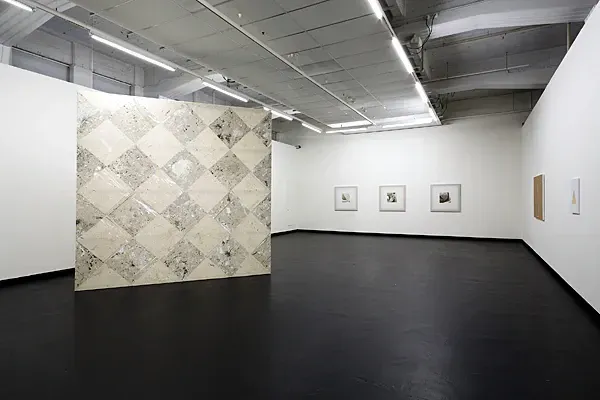
To the fourth, Andrew Barber my reaction is mixed. The works are cleverly made custom-fit to the space extending from floor to lighting rack, effecting the exhibition’s very pacing. More breathtaking however is when Barber is given an entire space, as in his current exhibition at Auckland’s Hopkinson Cundy. In his extension of materials, processes and approaches Barber is prodding the old formal grid of modernism into new territories, yet the idea of the work is sometime more interesting than its effect.
Still sometimes you surprise yourself. Art can be a slow burn. Take a smaller work by Barber at the Dowse in group show Man Made. Like the central work at City Gallery its surface is painstakingly stitched from many diamond parts by sailmakers. The stitching creates tension filled pinches, tugs and pulls across the surface, and a denim-like blue seems to progressively wash out down the canvas, as if we’re getting ever closer to the horizon. This is both clever and evocative.
Man Made’s theme of current male artists who work in textiles is a little broad for its own good. Pun intended, there are a few too many loose threads. At its core though there are a cluster of affecting surprising works where men are doing something you rarely see: paying tribute to their family’s heritage. There’s Rohan Wealleans surprising turn at delicately and playfully embroidering a family tree, Elliot Collins’ thin tribute to the old popular fad of string art and Zac Langdon Pole’s use of his mother’s fabric offcuts.
The show works well with Eve Armstrong’s installation downstairs Rise with its reconfiguration of discarded domestic fittings such as wardrobe racks and tiles, propped stacked and leant together. The best works respond in part to the vertical and tottering box like structures of the urban environment, and work with your physical place in the space. Strips and stripes of material reach, fall or are hung out to dry, with Armstrong’s customary delicate use of light and found blushes of colour.
- New Revised Edition, City Gallery Wellington, until 1 December. Manmade, The Dowse Art Museum, until 16 February
MUST SEE:
A luscious, luminous overwriting of surface that meditates on the digital world through paint. Ever inventive in the abstract, this is Hemer’s best show in Wellington yet.
- Stack Overflow, Andre Hemer, until 16 November