A director, scholar and Pericles
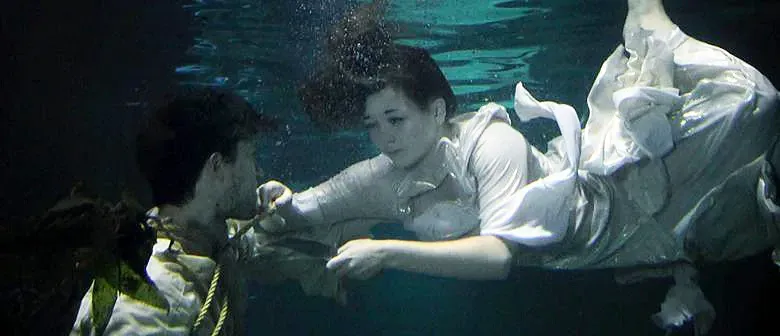
Pericles, Prince of Tyre is this year’s University of Auckland Summer Shakespeare production.
Renee Liang posed some questions to director Geoff Allen and Shakespearean scholar Professor Tom Bishop who worked together to develop a text which stays true to the original while incorporating a contemporary spirit.
* * *
One of the lesser known of Shakespeare’s plays, yet always popular with audiences, this is thought to be the premiere of Pericles in Auckland. A rollicking tale of high seas, pirates, betrayal and love lost and found, the production with a modern makeover promises to be a night of great fun (and verse) featuring a large cast, a live band and, intriguingly, a cricket match at interval.
Director Geoff Allen

Why did you decide to do Pericles this year?
I wanted to do something completely new - something I had no pre-conceptions about.
Have you directed a Summer Shakespeare before?
No, just acted in two.
Tell us about your cast. Was it difficult to cast?
The joy of this was that we could cast women in many of the roles. We created a large chorus, which has really helped when a few people pulled out - or had film jobs etc.
What is your favourite scene and why?
The reuniting of Pericles and Marina in act 5, is considered by many, to be Shakespeare’s finest piece of writing - but I like the bit where the fishermen tell the band to be quiet, so they can hear the cricket on the radio.
In this version of Pericles, you blend ancient and modern components; for example, the live band which plays contemporary covers and the cricket match at interval. What inspired you to do this?
The style of the play - always. I've learnt to trust my instincts. A voice in me said, 'Be bold on this one. Have fun - engage the audience.' The amazing thing about this play is that if you did it straight, it could be deathly. It's like Shakespeare is challenging us to be adventurous. I think, with the help of Tom and everyone, we've turned it into a damn fine script. " If we go to hell for this one - we'll be playing piano all the way down."
The play is notoriously difficult to stage - did you have any difficult technical moments?
When we got stuck, we just added in stuff like Gower saying, 'From Pentapolis to Tyre!' It's a road movie on water - so it moves around. My philosophy is keep it simple. I want the audience to see the theatrical devices. One actor plays several characters - at one point we see him change costume onstage. It means instantly the audience know - he's someone else now. But in the end it's about storytelling - and there's a real gem of a story in Pericles.
What are you working on next?
My play Sister Anzac at the navy museum. The major work of my life. It's about the NZ nurses on the hospital ship at Gallipoli - the closest women got to the boys on the hills - total hankie stuff. (Picture women tending wounded on the deck of a ship, as bullets hit around them) Alex Bonham is directing, and Gina Timberlake, my Galatea Theatre partner, will act in it. A labour of love for 4 years.
Professor of English, Tom Bishop

Why has Pericles never been performed in Auckland before?
I don't know the answer to that. And I don't know positively that it hasn't been performed — I have just found no record of a performance, and long-standing Aucklanders interested in Shakespeare whom I've asked have no recollection of one. It's probably a combination of the relatively unknown status of the play, the large size of the cast (which is expensive for professional companies), and the demands of the staging (storms, shipwrecks, pirates, etc).
There's debate about the true authorship of Pericles. What's your opinion?
There's no debate about Shakespeare's involvement in a substantial proportion of the play. It was always published as his and no-one has disputed that. The debate is over whether he wrote the whole and, if he didn't, who his collaborator was. My colleague, Mac Jackson, has done the best work in this area, and, to my mind, convincingly shown that it was a collaboration, and that the collaborator was a young playwright, George Wilkins, who had also written for Shakespeare's company, but whose career never really took off. Working with Shakespeare on Pericles, however it happened, was pretty much his high point.
Why is the play so popular with audiences, yet fiercely debated among academics?
It's popular because it tells a simple, direct and accessible story that has very wide appeal (a romance, an adventure story and a family reunion all rolled into one!), and contains powerful scenes of strong emotion movingly expressed. The scholarly debate has very little to do with those generally-acknowledged strengths, but looks at issues like "Why wasn't it printed in 1623 with Shakespeare's other plays?" and "Why is the original published script so uneven?"
There are many different versions of the text for Pericles. How did you produce your text?
My version is a quite conservative one compared with some others. I tried to stay as close to the original version as I could, while proposing reasonable solutions to the many problems of staging and language it presents along the way.
What changes have you made for this production and why?
In order to reduce the running time of the play, we cut some speeches and scenes down, especially where there was repetition or amplification within a single speech. Where there were awkward, unclear or incoherent sequences, we streamlined them to make the action flow better. To get the intermission in the best place, we had to intercut two separate scenes with one another. We also added a few verses in Latin for a tournament scene that takes place off-stage in the original.